How to choose your cycling glasses?
Whether you are a road cyclist, a mountain biker or simply an everyday rider, cycling glasses can be essential. Depending on how you ride, your needs and constraints are not the same: sun protection, protection against splashes, protection against wind and cold… Here is our focus on cycling glasses and the criteria to take into account when choosing them.
Buy our cycling sunglassesLens quality
Glasses are both a style statement and protection against the elements. For your eyes to be best protected and for you to benefit from the best lens treatments when cycling, lens quality is essential.
+ Lens protection categories
As with ski goggles, cycling glasses come in several categories of sun protection. Why? Quite simply because we do not have the same needs on a cloudy day as on a sunny day. You may also go on a road ride in winter and need glasses to protect yourself from the cold and damp rather than the sun. Glasses can also be necessary when mountain biking, to avoid splashes of water and mud, or to protect yourself from branches. Cyclocross enthusiasts know all about it!
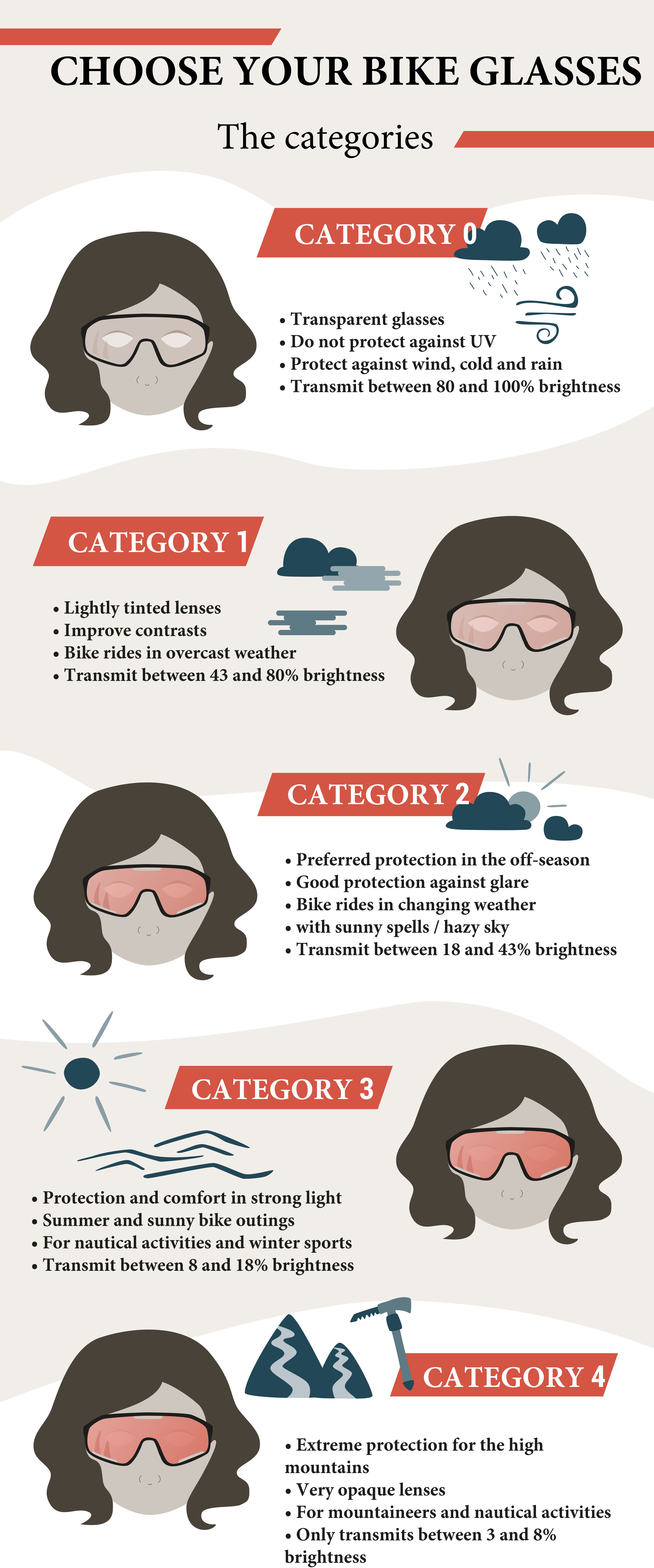
Cycling eyewear lenses are classified into five categories, from 0 to 4:
- Category 0: clear lenses, like those of prescription glasses. These lenses are not intended to protect against UV or glare, but rather against wind, cold and rain. They transmit between 80 and 100% of light;
- Category 1: these slightly tinted lenses provide visual comfort for cyclists because they improve contrast. Perfect in overcast weather, category 1 lenses transmit between 43 and 80% of light;
- Category 2: the protection to favour in spring and autumn. Category 2 lenses offer good protection against glare. They are suitable for rides in moderate sunshine and when conditions are changeable, alternating between sun and cloud. Category 2 lenses let through 18 to 43% of light;
- Category 3: widely used by cyclists in summer, these lenses offer protection and excellent comfort in bright light. Perfect for summer rides, they transmit only 8 to 18% of light. Excellent shields for your eyes in very sunny conditions, category 3 lenses are also recommended for water sports and winter sports;
- Category 4: it is very unlikely that you will need category 4 lenses, as they are intended for high mountains. These very dark lenses offer extreme protection. Transmitting only 3 to 8% of light, they are particularly suitable for mountaineers and water sports.
+ Lens technologies
Photochromic, polarised, high contrast lenses: what advantages can these lens technologies bring to your cycling?
- Photochromic: this revolutionary technology allows lenses to adapt to light conditions. Rather than buying cycling glasses sold with interchangeable lenses of several categories, photochromic lenses adapt to the brightness. They cannot cover all categories (0 to 4), but are offered in several ranges: categories 1 to 3, 2 to 3, 2 to 4. Versatile, these glasses require no handling. At Bollé, Phantom photochromic lenses ensure precise visual acuity whatever the weather: as the light changes, the lenses go from category 1 to 3 in less than 30 seconds;
- High contrast: how about cycling glasses that enhance colours and slightly accentuate contrast for better vision? High contrast lenses increase the perception of colour and depth while keeping a natural perception of whites. With Volt+ high contrast technology, Bollé cycling glasses increase colour perception by 30% thanks to their patented formula;
- Polarisation: it helps avoid reflections. A polarised lens cancels the glare of the sun's rays reflecting off tarmac, water and snow. While this is essential in the mountains, due to the strong reflection off snow, or for water sports with reflections off the water, it is also important for cycling glasses: flat surfaces such as roads also reflect light. This reflected sunlight, called "polarised light", is very dazzling.
+ Lens treatments
To bring you more comfort, improve your performance and offer you more safety on the bike, lenses can be equipped with treatments: anti-fog, anti-scratch, hydrophobic, etc.
- Anti-fog treatment prevents condensation. This mainly appears in winter when the air is cold and your body is warm from the effort. The heat coming off your face causes the lenses to fog up. This is particularly uncomfortable because it affects visibility and increases the risk of a fall. The anti-fog treatment prevents fogging on your glasses;
- Anti-scratch treatment: as its name suggests, it strengthens the lenses and prevents scratches. This treatment is added to polycarbonate and plastic lenses to better protect them. It is strongly recommended for mountain bikers and cyclocross enthusiasts;
- Hydrophobic and oleophobic treatment: it prevents water marks on the lenses by helping water drops run off. The result: instead of staying on the lens, drying and leaving marks, the drops slide off as they would on a waterproof jacket.
Comfort and look of cycling glasses
While choosing the lenses of your cycling glasses is fundamental, it is also important to look at their shape and weight.
+ The frame
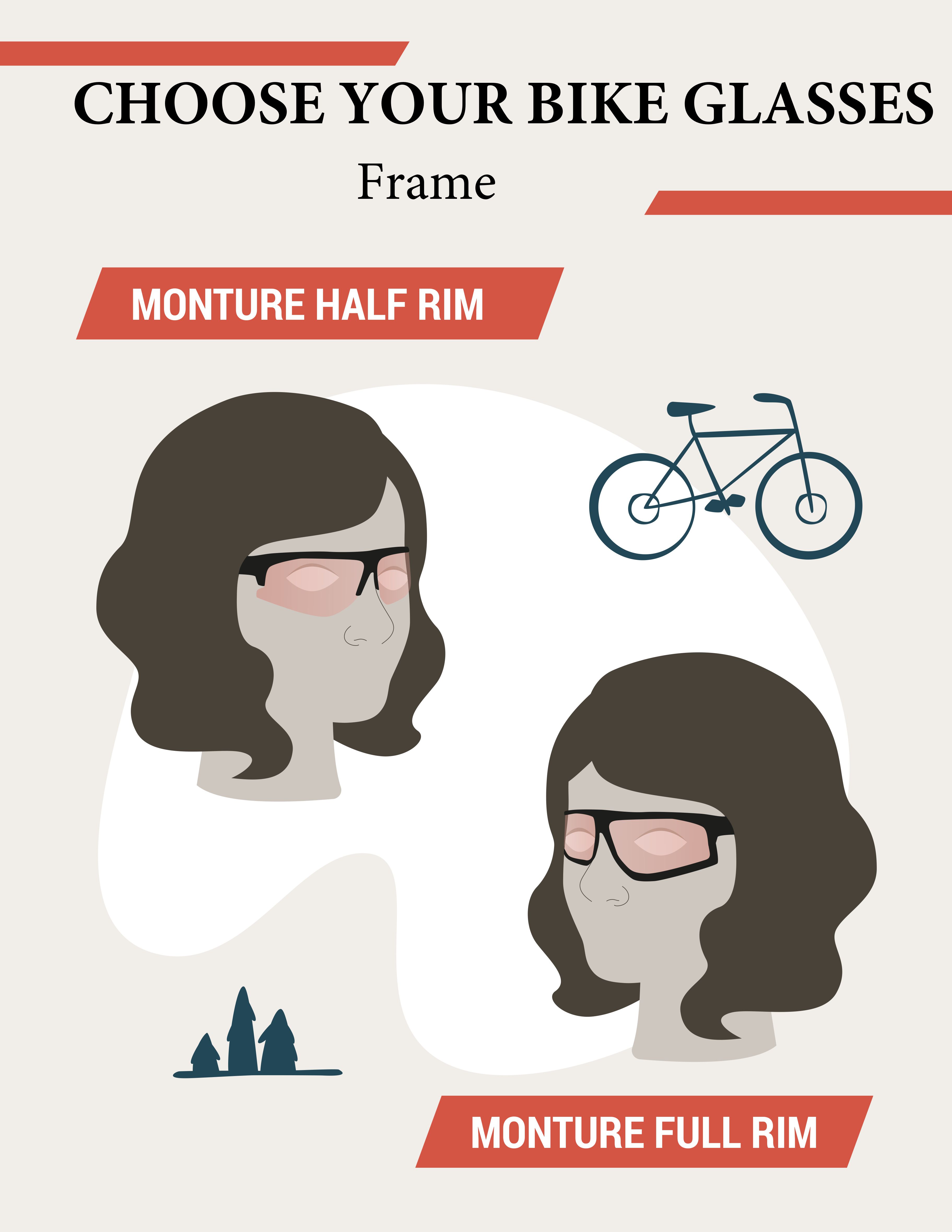
There are two types of frames on cycling glasses: full rim and half rim. Half-rim glasses are lighter and offer more ventilation because the lens has no frame at the bottom. Don't worry, full-rim frames are also designed with vented lenses to promote air circulation.
Looking for performance glasses for cycling? Bollé expands its range with the C-Shifter. This pair of glasses is at the forefront of performance and trends. With its cylindrical design that perfectly follows the shape of the face, it has a half-rim structure for perfect ventilation and extra lightness, combining performance and comfort.
+ Single lens or dual lens
With single-lens eyewear, one lens makes up the whole front of your glasses. A single lens offers a wider field of vision and more effective protection from the wind. But for everyday use, a single lens is harder to wear as it has a very road-cycling look. Dual-lens glasses are easier to wear every day. They are also lighter, and the lenses are easier to replace than a single lens if there is a problem.
+ The nose pad
Some cycling glasses are designed with an adjustable nose pad. This allows you to adjust your glasses to the shape of your face and be perfectly comfortable on your bike thanks to a secure fit.
+ The temples
Speaking of fit, the temples also have a role to play. The grip on the temples of your cycling glasses must ensure they stay stable.
Which glasses for which type of cycling?
Road bike, mountain bike or city bike for your journeys? Each practice has the right glasses.
For road or mountain bike rides, it is important to choose well-ventilated glasses. Also opt for a single lens, which offers a wider field of vision and better protection from the wind.
On the road, remember to choose the lens category suited to the light, or opt for photochromic lenses for their versatility. Polarised lenses are also strongly recommended in summer to avoid glare from the sun reflecting off the road.
When mountain biking, an anti-scratch treatment is essential to protect your lenses from splashes. A hydrophobic and oleophobic treatment is also a must, especially if you ride in winter when the trails are muddy and the weather is wet.
If you ride your bike every day for your trips around town, go for lifestyle sports glasses. Their full-rim frame combined with dual lenses offers a more versatile look without compromising on eye protection.
How to take care of your cycling glasses?
During a bike ride, even without mountain biking, glasses get dirty. Rain, splashes, dust: the lenses get dirty, but so do the frames due to sweat. So how do you take care of your cycling glasses? To clean them, we advise you to run them under water. Rinse the whole pair (lenses, temples, etc.) and pay particular attention to the lenses, as they get the most dirt. Cleaning with lukewarm water is enough: no need for soap, and especially no washing-up liquid, as the solvents it contains would damage the lenses.
Once the glasses are clean, use a microfibre cloth to wipe them.
When your glasses are dry, store them in their case. A hard case is recommended: it will prevent scratches, but also any risk of crushing and breakage if you store your glasses in a cupboard, drawer or glove box.
3 tips for choosing your cycling glasses
In summary, here are 3 key points to remember before buying your cycling glasses:
- Take into account the specifics of your practice;
- Choose a comfortable shape of glasses;
- Choose lenses according to their treatment and technology.