How to choose your ski goggles?
Good ski goggles protect your eyes from UV rays and guarantee optimal vision in good and bad weather. Your goggles will also provide excellent comfort in wind, cold or snowfall. How do you choose your ski goggles? What criteria should you take into account?
Buy our ski goggles
The different optical qualities of ski goggles
The optical qualities of your ski goggles’ lens should be number one on the list of items to check when considering buying a new pair.
+ Protection index and category
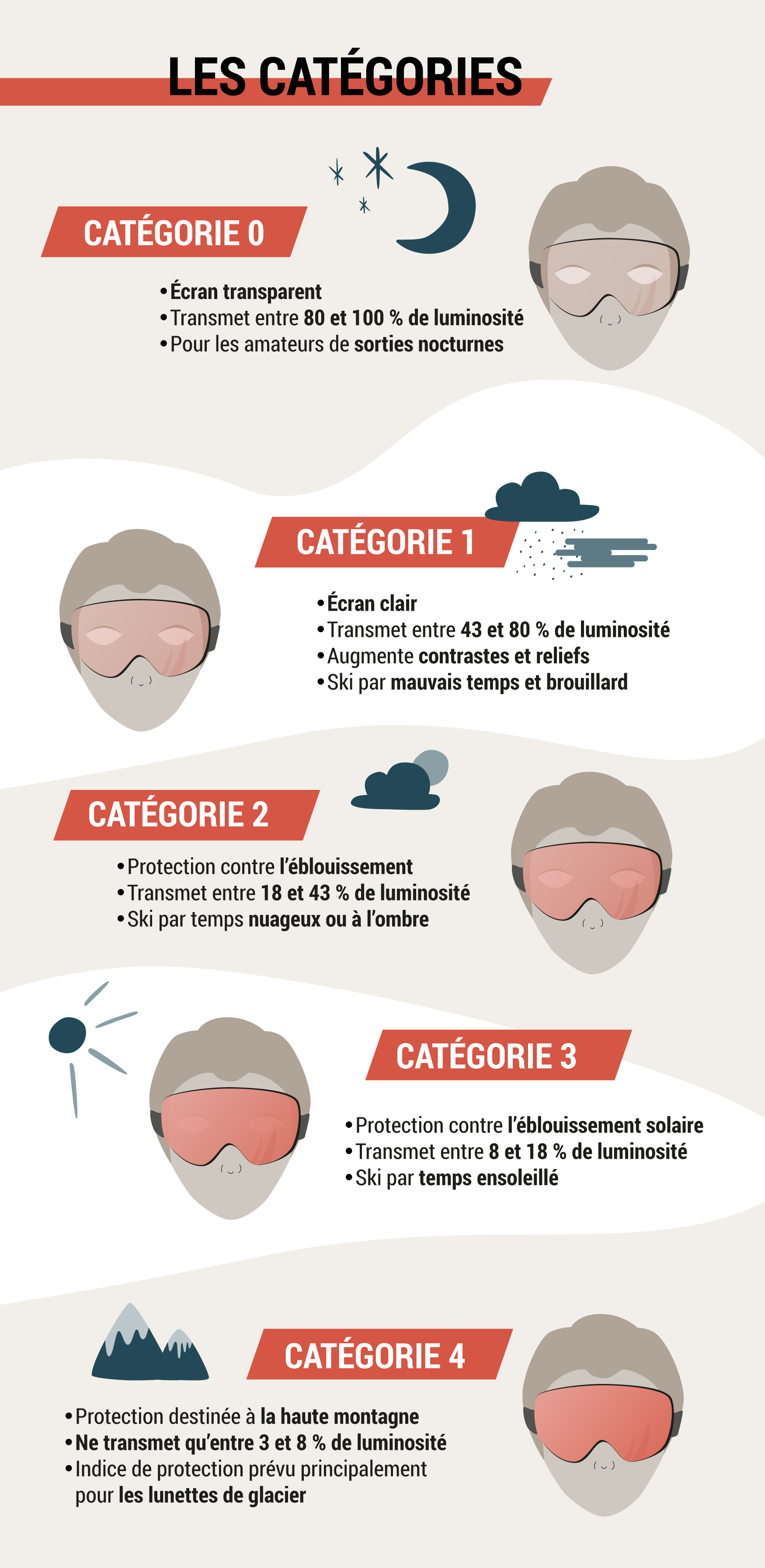
To choose your ski goggles, it is important to know in which conditions you want to ski: in good weather only? In difficult weather conditions? At high altitude? Even though all ski goggles filter 100% of UV rays, not all of them transmit the same amount of light. Depending on the weather conditions, you will therefore not have the same needs. This is why ski goggles are classified by solar categories. These 5 categories indicate the amount of light filtered:
- Category 0: transparent lenses. They let through 80 to 100% of light and are intended for evening / night-time use;
- Category 1: clear lenses allowing good visibility in cloudy weather. They transmit between 43 and 80% of light and thus increase contrast and relief. Ideal for skiing in bad weather and fog;
- Category 2: good protection against glare, letting through between 18 and 43% of light. These lenses allow you to ski in cloudy weather or in the shade. They are also suitable for sunny weather if you are not too sensitive to light;
- Category 3: ideal for a day's skiing in good weather as it effectively protects against solar glare. These lenses only transmit 8 to 18% of light for skiing in peace on sunny days;
- Category 4: intended for high-altitude terrain such as glaciers. These lenses only transmit 3 to 8% of light to ensure extreme protection and are not intended for general skiing. This protection level is rarely found on ski goggles and is mainly reserved for glacier eyewear.
+ Lens treatments
Ski goggle lenses benefit from numerous treatments to bring you maximum comfort and performance during your time in the mountains:
- Polarising treatment: applied to all category 3 ski goggles and to certain photochromic lenses. It increases contrast and reduces reflections. The polarising treatment offers real visual comfort and excellent optical definition;
- Anti-fog treatment: applied inside the lens after manufacturing, it is essential to prevent your ski goggles from fogging up. This treatment is now present on all ski goggles – the vast majority of which are also built with a double lens to limit fogging. To preserve the anti-fog treatment, it is recommended not to clean the inside of the lens when it is wet;
- Mirror treatment: it's not just an aesthetic choice. The mirror effect protects your eyes from the glare of the sun reflecting off the snow. The mirror treatment can come in different shades. On category 1 goggles, suitable for bad weather, the mirror treatment is often transparent. On category 2 and 3 ski goggles, you can play more with colours depending on the style you are looking for;
- Anti-scratch treatment: it protects the lens of your ski goggles from scratches.
The comfort of ski goggles
When choosing your ski goggles, you should pay attention to the elements that make them up, because every pair of ski goggles is different.
+ The structure
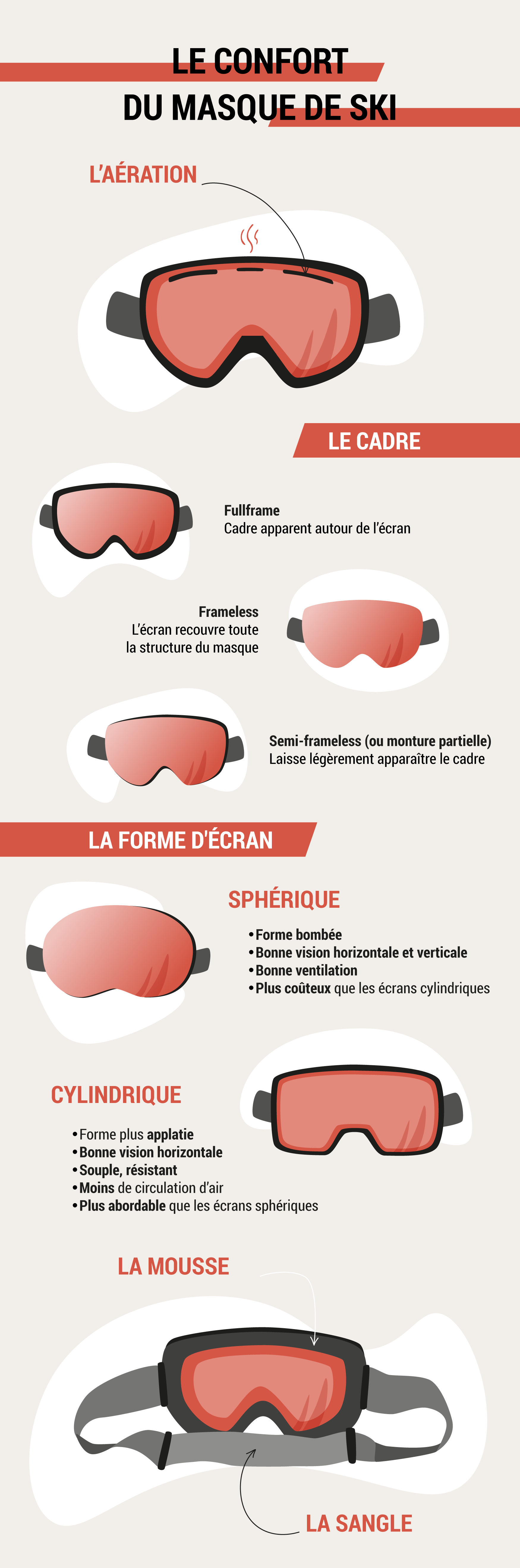
Ski goggles consist of a frame, a lens, foams, a ventilation system and a strap. From one pair to another, each element can be different.
+ The frame
The frame is the outline of your ski goggles. There are three different types of frame:
- Full-frame: the frame is visible and surrounds the lens;
- Frameless: this type of goggle has no visible frame and the lens covers the entire structure, providing a maximum field of vision;
- Semi-frameless: halfway between full-frame and frameless, this type of goggle gives pride of place to a large lens and only lets the frame show slightly.
+ The lens shape
There are two lens shapes:
- Spherical: spherical lenses are built – as the name suggests – around a sphere. They therefore have a curved, rounded, very trendy shape. Besides the style, they offer excellent horizontal and vertical optical vision and good ventilation. However, they are more expensive than cylindrical lenses;
- Cylindrical: flatter, cylindrical lenses offer a wide horizontal field of vision. This is the original lens design, giving a more vintage look. This type of lens is more flexible, more resistant and less expensive than a spherical one, but it falls short in terms of optical vision and airflow compared to its counterpart.
+ The foam
The foam is the part of your goggles that comes into contact with your skin. From the cheekbones to the forehead and nose, this foam follows the contour of the goggles. Ski goggles can be made with three types of foam: single, double or triple density. To be comfortable, it is better to opt for a high-density foam because it will adapt to the shape of your face. The ventilation foam placed around the edges of the goggles is less dense to prevent fogging.
+ Ventilation
As with a ski helmet, ventilation is important on ski goggles. It is made possible by the air vents built into the structure of the goggles, and also by the foams located on the upper and lower parts. But rest assured, ventilation does not mean feeling cold: the system is designed to circulate air to prevent fogging, not to let the cold in.
+ The strap
The strap is the headband of your ski goggles. Depending on the model, the strap can offer different options: easy adjustment to fit your head circumference, silicone anti-slip bands, etc.
Ski goggles suited to your practice
Which ski goggles for which use? As mentioned at the start of this buying guide, each lens category is suited to certain weather conditions. So how do you choose the most suitable ski goggles for your practice?
+ Single-lens ski goggles
This type of ski goggles comes with a single lens of category 0, 1, 2, 3 or 4. Category 1 and 2 goggles are the best sellers. Category 1 goggles allow you to ski in fog and bad weather, while category 2 goggles are very versatile. Single-lens ski goggles are suitable for occasional skiers, but may also suit more demanding skiers who will then take two pairs instead of one.
+ Ski goggles with interchangeable lenses
Ski goggles with interchangeable lenses allow you to change the lens depending on the weather. This type of goggle is generally sold with a cat. 1 lens and a cat. 3 lens, or a cat. 2 lens and a cat. 4 lens. Ski goggles with interchangeable lenses are aimed at those who like to ski in all weather conditions, and at freeride enthusiasts.
+ Photochromic ski goggles
Even better than goggles with interchangeable lenses, photochromic ski goggles adapt to variations in light. You don't have to do anything, your goggles take care of everything! Thanks to this technology, the lens tints according to the brightness. So, whatever the weather, you always see just as well. Photochromic lenses cannot, however, cover all categories from 0 to 4: a photochromic lens can cover categories 1 to 3, 2 to 3 or 2 to 4. These ski goggles are intended for on-piste skiers looking for versatile goggles.
+ Over The Glasses ski goggles
OTG ski goggles (Over The Glasses) are designed for wearers of prescription glasses. These goggles are deeper, allowing you to keep your glasses on underneath without any pressure points. The ventilation system of OTG ski goggles also helps prevent fogging.
Trying on your ski goggles: our tips
Ski goggles are not one size fits all. Some styles are designed for children, others for narrow faces, while some are designed for wider faces. That’s why we recommend that you try on your goggles before you buy them. Here are the points to check when trying on your ski goggles:
- You should be comfortable and not feel any compression on your forehead, nose, temples or cheeks;
- The foam should not reach the corners of your eyes;
- The goggles should feel sealed and fit snugly around the eyes.
If you wear a helmet when skiing, you should also try your ski goggles on with your helmet to make sure that:
- The strap is long enough for the goggles to fit over the helmet;
- The goggles are not too tight and do not create a pressure point;
- There is no gap between the top of your helmet and your goggles, to avoid the “cold bar”.
How to take care of your ski goggles?
To maximise the lifespan of your ski goggles, you can follow these tips:
- Store your goggles in their case for transport and storage, and avoid storing them in contact with objects that could scratch them, such as keys;
- Never wipe the inside of the lens when it is wet, to avoid damaging the anti-fog treatment. Wait until the lens has dried and clean it with a microfibre cloth;
- After a ski session, take the goggles out of their case to dry the foams. Dry them indoors but do not put them near a heat source (radiator, fireplace, stove, etc.).
What to remember when choosing your ski goggles
To choose your ski goggles, remember that there are:
- Several lens categories suited to different weather conditions (grey weather, sun, high mountains);
- Different lens shapes with different visual qualities;
- Lens technologies (single, interchangeable, photochromic) suited to your skiing practice.